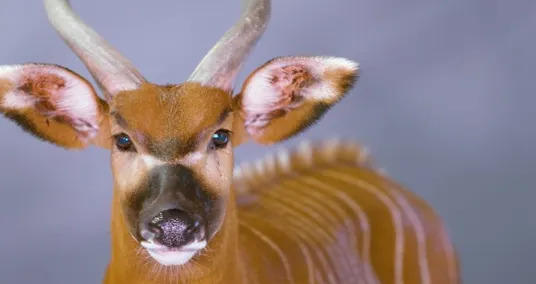
Deep within the forests of Kenya lives one of the most striking yet elusive antelopes in the world, the eastern bongo. Recognised for its rich chestnut coat marked with bold white stripes, this animal stands out as one of Africa’s most visually unique species. Despite its large size, the eastern bongo remains shy and rarely seen in the wild. It inhabits only a few isolated mountainous forest regions in Kenya, making its presence both special and fragile. Adult bongos can weigh between five hundred and nine hundred pounds, with long spiralling horns that can reach up to forty inches. These horns are not only impressive in length but also proportionally wide, matching the animal’s body size. As herbivores, bongos feed on leaves, shrubs, and forest vegetation, relying on dense cover for protection. They are most active during twilight and dusk, when low light helps them avoid predators. This behaviour, combined with their cautious nature, makes them difficult to observe even for experienced wildlife researchers. Their environment plays a crucial role in their survival, as the forests provide both food and shelter. However, this delicate balance is now under serious threat, placing the eastern bongo among the most endangered animals in Africa today.
The eastern bongo’s population has declined dramatically over time, with estimates suggesting that only around one hundred individuals remain in the wild. This number places the species well below the threshold for critical endangerment and highlights the urgency of conservation efforts. The primary threats facing these animals include illegal hunting and the destruction of their forest habitats. As forests are cleared for agriculture and human settlement, the safe spaces that bongos rely on continue to shrink. In response to this crisis, conservation organisations and local authorities in Kenya have taken important steps to protect the species. Certain forest regions have been designated as protected areas, allowing bongos to move freely without the constant threat of poaching. These efforts aim to stabilise and eventually increase the population, though recovery remains a long term challenge. Protecting the eastern bongo is not only about saving a single species, it is also about preserving the biodiversity of Kenya’s unique ecosystems. Each animal plays a role in maintaining ecological balance, and the loss of one can have wider consequences. The story of the eastern bongo serves as a powerful reminder of the impact human activity can have on wildlife and the importance of continued conservation action.
latest_posts
- 1
 6 Arranging Administrations to Change Your Open air Space
- 2How to Build a Yard That Helps Monarchs During Spring Migration
- 3From Overpowered to Coordinated: Individual Accounts of Cleaning up
- 4Yes, NASA's launching Artemis 2 astronauts to the moon on April Fools' Day. It's not a joke.
- 5Mississippi Insight for Jan. 11, 2026





- 'Everyone in this prison has had family killed or shot'
- Merck urges science-led US vaccine schedule after CDC trims childhood vaccine list
- Step by step instructions to Guarantee Your Internet Promoting Degree Supplements Your Profession Objectives
- 10 Demonstrated Systems to Develop Your Internet based Business
- The Electric Toyota Hilux Is Finally here, But It's Not Cheap
- The cave was pitch black – so to create this magical underwater shot, the photographer had to use all his camera expertise...
- Skeleton of famed musketeer possibly found in Dutch church
- David Duchovny's new thriller has him stripping down at 65. But its chilling premise hits close to home.
- NASA releases stunning first images of Earth taken by the Artemis II astronauts