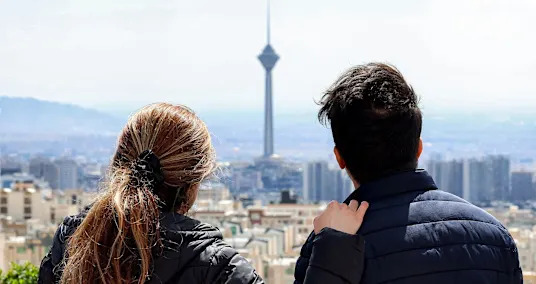
"He said to her: 'You're no longer my sister', and she told him to go to hell."
This argument between a man and his sister in a city near Tehran - witnessed and recounted by one of their relatives - gives a telling insight into the painful rows erupting among families and friends as US and Israeli strikes continue.
The relative, who we are calling Sina, says that when his family recently got together at his grandmother's house, emotions quickly exploded, exposing stark divisions.
His uncle, a member of the Basij - a volunteer militia often deployed to suppress dissent in Iran - refused to even greet his own sister, who is opposed to the ruling regime.
After their exchange, the uncle was "very quiet… and left early", Sina says.
He and other young Iranians have described emotional scenes as rifts open up over the war.
Even among those opposed to the government, there are deep divisions over whether the war will help or hinder attempts to bring about change.
Despite the government-imposed internet blackout, the BBC has been able to maintain contact with some of the few Iranians who have found ways to remain online.
Iranians can be sent to prison for speaking to certain international media. But even so, over the month-long war, these contacts have been sharing information through intermittent text messages and occasional voice calls.
Their initial responses of shock and fear have given way to attempts to adapt, switching locations and changing routines. They describe the details of their lives; practising yoga despite the sounds of explosions, eating birthday cake alone and venturing out to near-empty coffee shops.
And, in some surprisingly personal notes, they have shared details about how the conflict is affecting their relationships. All of the names in this article have been changed.

Towards the end of March, Iranians celebrated Nowruz, the Persian new year festival that marks the spring equinox and is often a time when families get together.
Sina, who is in his 20s, is opposed to the clerical establishment and continues to support the Israeli and US air strikes, believing that they will help bring the regime down.
He says his uncle, the Basij member, had not attended Nowruz family gatherings in recent years, but turned up this time, to the surprise of his family. Usually, "we don't talk to him, nor to his children", says Sina.
He says he has barely spoken to his uncle since major protests in 2022 following the death in custody of a young woman, Mahsa Amini, who was accused of not wearing the compulsory hijab properly.
More recently, Iran saw an unprecedented crackdown by the Basij and other security forces on protests that swept across the country in December and January. At least 6,508 protesters were killed and 53,000 arrested, according to the US-based Human Rights Activists News Agency (HRANA).
Sina says that, according to other relatives, his uncle was so angered by the protests that he said even if his own children went onto the streets and were killed, he wouldn't go to collect their bodies.
And yet, Sina says, his uncle seems to be "afraid of dying" in the war and appears to have been trying to improve relations with some family members, including his own mother, Sina's grandmother.
At Nowruz, he and his wife "just looked really down and helpless", says Sina. "I didn't get into an argument with them. They should be in prison."

Another young man, Kaveh from Tehran, spent Nowruz alone.
He says his relationship with his sister, who is also a Basij member, was already difficult. After he joined the 2022 protests, he says, she became critical of his activities and unsympathetic over the deaths of friends of his in the January protests.
Kaveh has been providing internet access to friends and family via SpaceX's Starlink, which offers connectivity via satellites. In Iran, owning or using Starlink terminals is punishable by up to two years in prison.
He initially joined his family for the holiday, but he says he left the place where they were staying and later returned to find his sister had disconnected his Starlink and the devices connected to it. When he challenged her, a row broke out, he says.
"I can't stand her anymore… I just had a fight and said I can't stand it and I left," he says.
"I was so excited about Nowruz. I packed my clothes and wanted to be there with the family," Kaveh said over an encrypted line as he travelled home alone. "But now I don't feel it at all."

Most Iranians have no internet access. Starlink devices are expensive as well as illegal, so those who have access tend to be relatively wealthy. A few others manage to connect via VPNs.
Most Iranians who agree to speak to BBC Persian are opposed to the Iranian regime. But even among the government's critics, there are deep differences over this war and its impact.
According to the International Federation of Red Cross and Red Crescent Societies, 1,900 people have been killed in Iran by the US and Israeli strikes, while HRANA puts the total at over 3,400, more than 1,500 of them civilians.
Maral, a student in her 20s in the city of Rasht in northern Iran, has become very frustrated with her father for his continued support of the war.
He is an enthusiastic supporter of Reza Pahlavi, the crown prince of Iran before the 1979 revolution.
Pahlavi now lives in the US and has positioned himself as a potential transitional leader of the country. He supports the US and Israeli strikes on Iran despite mounting casualties, describing the attacks as a "humanitarian intervention" and recently urging the US to "stay the course".
He has gained traction in Iran in recent months as an opposition figure, with some demonstrators in the January protests chanting his name.
"I just want this war to end as soon as possible," says Maral. "Many ordinary people have died."
She says she gets "annoyed" because her father is "really optimistic", even as the bombs fall.
"We try to talk to him, but he just keeps going on about 'the Prince, the Prince,'" she says.
"My dad lives in this illusion that Iran will open up its borders and within five years everything will be rebuilt, everything will be fine. He's being influenced by Israeli propaganda that the two countries will be friends."
Her father and mother often argue about Pahlavi, she adds.

Meanwhile, Tara, a woman in her 20s in Tehran, says her close family members initially criticised her for being opposed to the war.
"They all support attacks on Iran… My mum and sister told me: 'You haven't lost anyone [during the protests], that's why you are against the strikes. You don't want your routine, exercise and coffee catch-ups to get disrupted… If they [the regime] had killed one of your friends or relatives [during the protests] you would have a different opinion.'"
But Tara says: "Thousands of innocent people could be killed in the war as well, without anyone even remembering them."
However, she says, her sister's view – like that of several other Iranians the BBC has heard from - has softened as the attacks have continued. More recently, after a nearby area was hit, she says her sister simply said: "I hope the war finishes soon."
And despite their differences, the family still try to go everywhere together, Tara says. That way, "we would all die together if they hit us".
latest_posts
- 1
 Living Abroad: Social Inundation and Self-improvement
 - 2Floods, Landslides Triggered By Heavy Rain In Afghanistan Leave 77 Dead In 10 days, Authorities Say
- 3Nepal’s youngest premier sworn in after releasing new rap song about unity
- 4How to watch 'Tell Me Lies' Season 3: Episode release times, streaming info and more
- 5Two more UN peacekeepers killed in southern Lebanon: UNIFIL


- How HIV/AIDS got its name − the words Americans used for the crisis were steeped in science, stigma and religious language
- Charli xcx recorded original songs for 'Wuthering Heights' — what to know about the new album for Margot Robbie's film
- Brazil approves law strengthening protective measures for female victims of gender-based violence
- Dozens of hidden star streams found in the outskirts of our Milky Way galaxy
- NASA's Perseverance Mars rover could break the record for miles driven on another planet
- Humpback whale stranded on Germany's Baltic coast frees itself
- Peruvian ex-President Martin Vizcarra sentenced to 14 years in prison
- Dramatic Dominance d: A Survey of \Feelings in front of an audience\ Theater Play
- Germany expresses 'great concern' over Israel's new death penalty law